I know most of the people who live on my street - which is only somewhat true. I know most of the people's vehicles who live on my street.
The people who live about a quarter mile away on a back lot just sold their house and moved recently. I had never actually talked to them, but they drove a PT Cruiser. From what I could see as they drove by, usually while I was walking one of the dogs, they were older - meaning they may have been around my age or maybe older. They always smiled and waved. But even people who probably would not like me smile and wave as they go by.
I don't remember the last time I woke up after the sun had risen, or even as the sun was rising. I generally find that once I wake up, the best thing for me to do is just to get up - regardless of the time. As much as it may pain the 16-year-old-me who has long since gone extinct, I am a morning person.
The first thing I do after I get up is put the dogs out. My younger dog always hear me walking toward the dog room. My older dog, deaf for years now, usually needs to be woken up.
At one time, we were the new neighbors on this street. Now there are new neighbors at the house that just sold. And three doors down in the other direction, new constructions is building another house. It was early December when I moved into this house. Coming from an old Victorian house down in the holler that is Main Street of the township, SO and I were enamored with the sunrises and sunsets. A house out to the west - quite a ways away - has a floodlight of some kind. This looks like a yellow sodium vapor light that is old enough that it may be starting to dim. I can only see this light in the late fall through spring. The house sits low, near the horizon so trees (and probably hateful honeysuckle) blocks the light from view at other times.
I've grown accustomed to that yellow light, but on first moving in, I hated it. It spoiled otherwise stunning sunsets. Looking to the west after dark, that yellow light remains defiling the sun's canvas.
I'm really not sure how old my older dog is as she was a rescue dog. I was told that she was around 4 when I got her, but she was already starting to show some significant grey in the face. When I told the vet the assumed age, he hesitated, raised an eyebrow, "Um, maybe. Maybe five, or six."
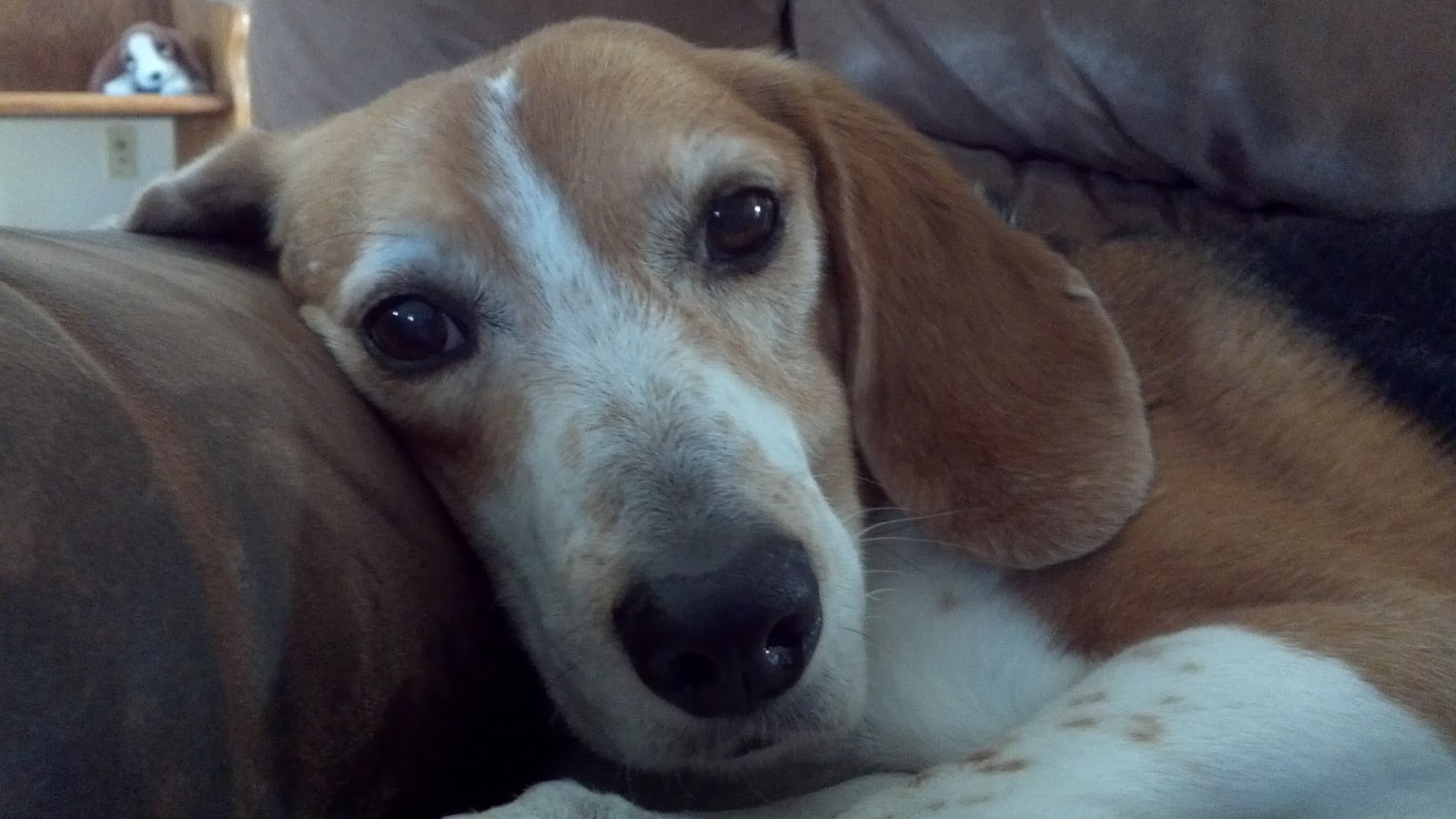
She is the most aloof, yet affectionate dog I've ever had. She can no longer go on anything but the shortest walks. At times she can still jump on the furniture; other times she just puts her front paws up and looks at me. She tends to look annoyed when I lift her onto the couch. Aloof but affectionate. I suspect I'll have the same level of obstinateness when I can no longer metaphorically jump on the couch.
When I let the dogs out first thing in the morning, I often pause to look up in the sky on clear mornings. Living in a rural area, the stars shine brightly. Even though I still want to visit an area with very low light pollution - I've never been able to see the painted swath of the Milky Way. I have been lucky enough to have seen some fantastic meteors first thing in the morning.
The new people on the street have put up a shockingly bright security light that remains lit through the night. Unlike the house to the west, this is not a dimming sodium vapor light, but appears to be some new-fangled bright white LED. I have very quickly grown to detest that light. I'm fearful if I ever meet these new neighbors, I'll instantly say something like, "Ah, the sons-a-bitches with that bright-ass light?"
I'm curious about the intentions and level of fear that necessitated such a bright light to be lit all night. I suspect a similar reaction as to when someone new immigrant to this rural area complains about getting behind a trundling combine in the fall - what did you move to a rural area for? Shouldn't darkness be a virtue of a rural area, just like farm equipment or cow poop is celebrated? Or dogs barking? Or sassafras trees being destroyed by whitetail bucks overcome with aggression in the fall? Did these new neighbors come from a suburb, and bring with them the primordial fear of darkness that led primitive Homo Habilis to huddle by the safety of a fire at night?
I worry about my older dog. She has been diagnosed with cancer and is approaching borrowed time. Along with her hearing, her sense of smell is diminished to the point it is difficult at times to get her to eat. But it doesn't take much to keep her happy. Make sure she has water. Give her a few treats per day. Help her on the couch even if she groans about it. And let her out every few hours. The neighbor's lights don't seem to bother her at all.
Showing posts with label Dogs. Show all posts
Showing posts with label Dogs. Show all posts
Sunday, November 26, 2017

Wednesday, August 2, 2017
Veterinarian Heal Thyself

It isn't the money. It isn't the dog's age. It isn't that I believe her age has been underestimated. It isn't the time commitment. It isn't the dog's overall health. It isn't longevity versus quality of life. It isn't the effects that the treatment might have on her. It isn't her inability to tell me what she wants. It isn't that she is an absolutely awesome dog. It is everything.
After loosing my oldest dog a few months ago, my now-oldest has been diagnosed with cancer. This is pretty devastating as I was anticipating her living as long as the last two did. Even without cancer, that would be unlikely.
The veterinarian noticed a small growth during an annual check up. The vet didn't seem too concerned, but suggested it be removed and tested just to be sure. "Within the next few weeks." Once I knew where it was, it bothered me and removal came sooner rather than later.
It was probably a good thing it was removed as the histology report stated it was a rather aggressive form of cancer. I was shocked by this; I had anticipated it would be just another benign growth - all my dogs have had these to at least some extent.
My vet referred me to a veterinarian oncologist. I made an appointment and took her to see the cancer doctor. The oncologist laid out some of the options, and none of them sounded very good to me. The best option would likely give her several additional months to live, with a high degree of variability. It would not cure her, but it would not be impossible for her life to be extended by years. Maybe. But maybe it would do nothing. Digging into this option told a very incomplete story. There are few good controlled studies, and the studies that have been done have shown a lot of variability with some conflicting results. While several months is a huge advancement to the medical profession in the face of a terminal diagnosis, it is small comfort in the big picture. Quite frankly, this best option sounded like only a few steps removed from an uncontrolled medical experiment. I guess that is why it is called a medical practice and not a medical certainty. I wish I could say that cost was not a factor, but it was.
Questioning financial motivation of a pet's owner is easy. Questioning the morality of spending tens of thousands of dollars on an aging pet when there are people without health care is easy too. Does anyone question the financial motives of the veterinarian and the clinic? That nice new building is being paid for by someone though. The vet is only there to help - right?
I was there with my dog to see the oncologist, but was feeling judged at some point through the conversation.
Surgery - what was already done and may be needed again is a treatment. Our usual veterinarian was able to completely remove the tumor with some margins. Success does not necessarily mean cure.
More judgement was seeping into the small examination room.
Radiation was not a good option on this type of cancer and would likely come with a significant reduction in the quality of life.
Chemotherapy, while well tolerated by most dogs has not historically been very effective on this type of cancer either. "So would chemo be that much better than not treating at all?" after much discussion about that as an option.
"Not in my opinion," the Oncologist replied.
More judgement.
A veterinarian's job is to heal the patient. A veterinarian's job is not to do nothing. I've yet to meet a vet who I didn't believe was compassionate. While personable and friendly, the oncologist was compassionate in the same perfunctory way that a vending machine is - there are all these options, all will be bad for me.
Maybe I'm judging the oncologist as well.
My dog was resting on the floor staring at the wall. She didn't want cancer. She didn't want aggressive or expensive treatments. She wanted to be back in her familiar back yard. She really just wanted to be at home on the sofa.
"We could start treatment today," the oncologist said.
But it was too much to think about right then. There was too much information and not enough at the same time. These decisions are never, ever easy; there is no help in making them. I needed time to think.
The judgement was hanging thick in the silent room.
I looked away from the oncologist. The freshly painted walls were done poorly; the judgement made it hard to see the small paint drips on the floor.
The only thing I could be sure of was that my dog was not judging either one of us.

"The cold compassion of bartenders, he came to see, was like that of priests: universal rather than personal, with charity for all and malice toward almost none. Firmly situated … between sacrament and communicant, they commanded rather than earned love, trust, dependence." - John Crowley
Saturday, July 29, 2017
Dog Days
I don't believe any of the houses I grew up in had air conditioning. A few of the apartment's I lived in during and after college had it, but I wasn't in those long enough for that to become the norm.
Admittedly, in Michigan where I grew up there are more cool nights than there is in a place like Tillman's Corner, Alabama, but summer's heat could still be oppressive with its evil friend humidity. My parents always said the best thing to do was to put a fan in the window at night, either blowing cool air in, or warm air out overnight. I always wanted the thing directly cooling me off.
We're in the midst of the dog days of summer.
dictionary.com defines the Dog Days as:
"The sultry part of the summer, supposed to occur during the period that Sirius, the Dog Star, rises at the same time as the sun: now often reckoned from July 3 to August 11." Sultry... Reckoned...
I've always been partial to the definition from the William Armstrong's Sounder, even if it is incorrect:
"the heat is so bad the dogs go mad"
I'm not sure if she's mad, but my dog clearly lets me know when the walk gets too long during the dog days. She knows where the shady spots are along the road and what to do when she gets there.

This past week has had a brutal combination of heat and humidity. Lows overnight were around 70. And while highs were only around 90, humidity was almost tropical in nature with dew points above 70 degrees at time. The hot and humid days can be ugly, but the nights can be near hateful - I'm reminded of the first few years after moving to Southern Ohio. If my memory is correct, I moved into my house in February, with the huge opposing furnace heating and drying the air. As that first winter transitioned to spring to summer, the area showed what we were in for. The dog days of summer were unpleasant. Getting home after work to a house that never felt like it dried out. My parent's counsel to use fans in the windows was augmented by fans blowing over the bed. The house sat in a holler, so humidity would often pool in the slightly cooler, lower air. The effect was cooler soupy air was pushed around overnight only to be turned into hot soupy air during the day. Overnight thunderstorms would bring a separate set of problems.
I tried to remain stoic about it, "I've never had air conditioning."
"Well, how was sleeping last night?" Janet asks, smugly.
I didn't admit it, but it was miserable. At that time, I probably could have afforded a window air conditioner, but it would have been a stretch. And I wasn't sure how much additional cost would come with actually using it.
Eventually, Bill gave me his old air conditioner as he got his central system fixed as preparation for selling his house. This was an enormous window unit - thankfully the house had large windows. It was loud and shaky and it seemed to want to give up overnight, but the slightly cooler and drier air it created in the evening allowed sleep to come less fitfully on most nights. For some reason, paper wasps loved to make nests in that window air conditioner.
That free unit was eventually replaced with a far more efficient window air conditioner upstairs and a second larger unit downstairs. I've always hated window air conditioners though. No matter how well they are secured, much of the construction of modern units is plastic and they seem a desperately weak security risk. In my case, the risk was probably minimal for the second floor, but despite doing what I could to secure it, the ground floor always made me nervous. And since getting really good sealing around a window air conditioner isn't easy, I always assumed it was a convenient entry point for bugs as well as burglars.
At some point, discomfort and anxiety made getting central air conditioning a better solution. Quite frankly, it didn't cost all that much and by getting a heat pump it helped with winter bills as well. But as the house was well over 100 years old, with several retrofits from what was likely the original fireplace and coal furnace heating system, all cold air returns (that did anything) were on the first floor. Some cooling reached the second story helped by a fan at the top of the stairs. But a window unit was still needed upstairs might have been helpful on the worst days. I didn't know it at the time, but I was only able to enjoy the central air conditioning for a couple years until I ended up moving.
I'd like to believe I'm not soft, but I'm quite sure returning to a lack of air conditioning would be painful. Childhood tolerance is long gone. Still, not only have I lived for most of my life without air conditioning, but people have for millennia. If there was a drastic change in circumstances, I could try to resurrect the stoic tolerance of my ancestry.
As Mark Chesnutt sang in 1990:
"These old dog days of summer
Lord, I'll be glad when they're gone..."
Admittedly, in Michigan where I grew up there are more cool nights than there is in a place like Tillman's Corner, Alabama, but summer's heat could still be oppressive with its evil friend humidity. My parents always said the best thing to do was to put a fan in the window at night, either blowing cool air in, or warm air out overnight. I always wanted the thing directly cooling me off.
We're in the midst of the dog days of summer.
dictionary.com defines the Dog Days as:
"The sultry part of the summer, supposed to occur during the period that Sirius, the Dog Star, rises at the same time as the sun: now often reckoned from July 3 to August 11." Sultry... Reckoned...
I've always been partial to the definition from the William Armstrong's Sounder, even if it is incorrect:
"the heat is so bad the dogs go mad"
I'm not sure if she's mad, but my dog clearly lets me know when the walk gets too long during the dog days. She knows where the shady spots are along the road and what to do when she gets there.

This past week has had a brutal combination of heat and humidity. Lows overnight were around 70. And while highs were only around 90, humidity was almost tropical in nature with dew points above 70 degrees at time. The hot and humid days can be ugly, but the nights can be near hateful - I'm reminded of the first few years after moving to Southern Ohio. If my memory is correct, I moved into my house in February, with the huge opposing furnace heating and drying the air. As that first winter transitioned to spring to summer, the area showed what we were in for. The dog days of summer were unpleasant. Getting home after work to a house that never felt like it dried out. My parent's counsel to use fans in the windows was augmented by fans blowing over the bed. The house sat in a holler, so humidity would often pool in the slightly cooler, lower air. The effect was cooler soupy air was pushed around overnight only to be turned into hot soupy air during the day. Overnight thunderstorms would bring a separate set of problems.
I tried to remain stoic about it, "I've never had air conditioning."
"Well, how was sleeping last night?" Janet asks, smugly.
I didn't admit it, but it was miserable. At that time, I probably could have afforded a window air conditioner, but it would have been a stretch. And I wasn't sure how much additional cost would come with actually using it.
Eventually, Bill gave me his old air conditioner as he got his central system fixed as preparation for selling his house. This was an enormous window unit - thankfully the house had large windows. It was loud and shaky and it seemed to want to give up overnight, but the slightly cooler and drier air it created in the evening allowed sleep to come less fitfully on most nights. For some reason, paper wasps loved to make nests in that window air conditioner.
That free unit was eventually replaced with a far more efficient window air conditioner upstairs and a second larger unit downstairs. I've always hated window air conditioners though. No matter how well they are secured, much of the construction of modern units is plastic and they seem a desperately weak security risk. In my case, the risk was probably minimal for the second floor, but despite doing what I could to secure it, the ground floor always made me nervous. And since getting really good sealing around a window air conditioner isn't easy, I always assumed it was a convenient entry point for bugs as well as burglars.
At some point, discomfort and anxiety made getting central air conditioning a better solution. Quite frankly, it didn't cost all that much and by getting a heat pump it helped with winter bills as well. But as the house was well over 100 years old, with several retrofits from what was likely the original fireplace and coal furnace heating system, all cold air returns (that did anything) were on the first floor. Some cooling reached the second story helped by a fan at the top of the stairs. But a window unit was still needed upstairs might have been helpful on the worst days. I didn't know it at the time, but I was only able to enjoy the central air conditioning for a couple years until I ended up moving.
I'd like to believe I'm not soft, but I'm quite sure returning to a lack of air conditioning would be painful. Childhood tolerance is long gone. Still, not only have I lived for most of my life without air conditioning, but people have for millennia. If there was a drastic change in circumstances, I could try to resurrect the stoic tolerance of my ancestry.
As Mark Chesnutt sang in 1990:
"These old dog days of summer
Lord, I'll be glad when they're gone..."
Friday, July 14, 2017
Mephitidae Financial Distress
As I let the dogs out first thing in the morning, the younger dog streaked over to the barn chasing something. I didn't think much of this as it usually means a bunny was nearby. After an uncharacteristically short time, she came running back to the gate into the back yard accompanied by the overwhelming smell of skunk. My morning did not start well.
Torrential rain started a few minutes later.
A quick internet search gave a few home remedies for dealing with a skunk-sprayed dog, and SO and I were talking about what we were going to do with the dog. Immediately after I saw a bolt of lightning strike the ground close enough to be seen out the kitchen window, there was a loud pop and flash behind the stove. The house had just been hit, or at least affected by, lightning.
The dog got two baths, the first from a mixture of hydrogen peroxide, baking soda and dish-washing detergent; the second with our current normal dog washing soap.
I took a look around the house and didn't see any effects of the lightning bolt. The stove appeared to be working and none of the digital clocks were even flashing.
I did eventually make it out of the house and on to work, but it was late by my normal routine. I was thinking about what a pain it is having to deal with a skunk-sprayed dog and the potential for very serious issues from a lightning strike when something on the radio brought me back to reality. Other than being a bit late, nothing was really all that bad. So while the morning had not gone well, any problems looked like first world problems. I was still frustrated; as they say - hopefully tongue in cheek, "They may be rich white guy problems, but they are still problems."
Neal Gabler writes in a shockingly personal way about some of his own problems of a financial nature in a recent issue of The Atlantic. Despite having what most would consider a fairly successful career, he sounds as if he is mostly living paycheck to paycheck, or at best has lived paycheck to paycheck for much of his adult life.
One of the risks about writing so openly is that he has opened himself up to criticism. It is pretty easy to sit back and do arm chair financial planning after-the-fact. Sadly, both the Huffington Post and Slate did so very quickly and cast this with the specter of male versus female. Were that it was so easy; both Huffington Post and Slate instantly lose credibility and set back a cause which they claim to promote when they frame the problem on the base pairs of x and y chromosomes.
I can easily look back on bad financial decisions I've made over the years and if anyone says they can't think of any, they are bald-faced lying. What does the phrase "bald-faced" even mean?
In Neal Gabler's case, he made a couple doozies: Not taking the penalties of late taxes seriously, dumping a 401(K) to pay for a wedding (does his daughter have some responsibility for that - and why does everyone feel so compelled to sacrifice so much of the future on one event?) and creating severe hardship by buying a second house before selling the first (Ooops, I did that too).
But a bigger issue is lurking in that last poor decision.
Why, especially when one has chosen a field which might not be the most lucrative, live in New York? Or Los Angeles? Why live in Chicago when you can live anywhere as a professional writer?
I took a look at what Mr. Gabler has written, and he has five books about the entertainment industry. While the majority of what I read is non-fiction, none of these sounds very interesting to me, but I'm sure they must appeal to some. I can't believe that another book about Walt Disney was desperately needed. And an entire book about Barbara Streisand? It didn't work for Lucy, not sure it will work for Neal...
Meghan Daum made the sensible move to the Midwest when New York had threatened to bankrupt her, then oddly chose to move back to begin working towards poverty again.
New York, despite what it thinks, isn't the center of the universe. As I was walking my dog, pre-skunk, around the 5-mile block the previous weekend, I couldn't help thinking about how lucky I was to live in the Midwest. Of course the weather was nearly perfect, and even New York might be somewhat nice on a morning like that.
At some point however, financial issues seem to become math issues. And sympathy is a bit hard to come by for someone as educated as Mr. Gabler when it comes to relatively simple math.
So my first world issues even might be comparatively minor. The concoction of peroxide, baking soda and dish detergent worked relatively well - especially since the dog was washed off very quickly. I still haven't seen any issues as a result of the lighting strike.
But there might be something to learn about the fragile nature of everything from a dog, a skunk and a bolt of lightning.
There but for the grace of God go I.
Torrential rain started a few minutes later.
A quick internet search gave a few home remedies for dealing with a skunk-sprayed dog, and SO and I were talking about what we were going to do with the dog. Immediately after I saw a bolt of lightning strike the ground close enough to be seen out the kitchen window, there was a loud pop and flash behind the stove. The house had just been hit, or at least affected by, lightning.
The dog got two baths, the first from a mixture of hydrogen peroxide, baking soda and dish-washing detergent; the second with our current normal dog washing soap.
I took a look around the house and didn't see any effects of the lightning bolt. The stove appeared to be working and none of the digital clocks were even flashing.
I did eventually make it out of the house and on to work, but it was late by my normal routine. I was thinking about what a pain it is having to deal with a skunk-sprayed dog and the potential for very serious issues from a lightning strike when something on the radio brought me back to reality. Other than being a bit late, nothing was really all that bad. So while the morning had not gone well, any problems looked like first world problems. I was still frustrated; as they say - hopefully tongue in cheek, "They may be rich white guy problems, but they are still problems."
Neal Gabler writes in a shockingly personal way about some of his own problems of a financial nature in a recent issue of The Atlantic. Despite having what most would consider a fairly successful career, he sounds as if he is mostly living paycheck to paycheck, or at best has lived paycheck to paycheck for much of his adult life.
One of the risks about writing so openly is that he has opened himself up to criticism. It is pretty easy to sit back and do arm chair financial planning after-the-fact. Sadly, both the Huffington Post and Slate did so very quickly and cast this with the specter of male versus female. Were that it was so easy; both Huffington Post and Slate instantly lose credibility and set back a cause which they claim to promote when they frame the problem on the base pairs of x and y chromosomes.
I can easily look back on bad financial decisions I've made over the years and if anyone says they can't think of any, they are bald-faced lying. What does the phrase "bald-faced" even mean?
In Neal Gabler's case, he made a couple doozies: Not taking the penalties of late taxes seriously, dumping a 401(K) to pay for a wedding (does his daughter have some responsibility for that - and why does everyone feel so compelled to sacrifice so much of the future on one event?) and creating severe hardship by buying a second house before selling the first (Ooops, I did that too).
But a bigger issue is lurking in that last poor decision.
Why, especially when one has chosen a field which might not be the most lucrative, live in New York? Or Los Angeles? Why live in Chicago when you can live anywhere as a professional writer?
I took a look at what Mr. Gabler has written, and he has five books about the entertainment industry. While the majority of what I read is non-fiction, none of these sounds very interesting to me, but I'm sure they must appeal to some. I can't believe that another book about Walt Disney was desperately needed. And an entire book about Barbara Streisand? It didn't work for Lucy, not sure it will work for Neal...
Meghan Daum made the sensible move to the Midwest when New York had threatened to bankrupt her, then oddly chose to move back to begin working towards poverty again.
New York, despite what it thinks, isn't the center of the universe. As I was walking my dog, pre-skunk, around the 5-mile block the previous weekend, I couldn't help thinking about how lucky I was to live in the Midwest. Of course the weather was nearly perfect, and even New York might be somewhat nice on a morning like that.
At some point however, financial issues seem to become math issues. And sympathy is a bit hard to come by for someone as educated as Mr. Gabler when it comes to relatively simple math.
So my first world issues even might be comparatively minor. The concoction of peroxide, baking soda and dish detergent worked relatively well - especially since the dog was washed off very quickly. I still haven't seen any issues as a result of the lighting strike.
But there might be something to learn about the fragile nature of everything from a dog, a skunk and a bolt of lightning.
There but for the grace of God go I.
Saturday, June 3, 2017
The Walk of Shame
Some well-meaning group organized a blood drive when I was in college. A few of us were convivially joking with each other about some of the screening questions, "Have you been incarcerated for more than 72 consecutive hours?" I guess that is the magic time point. Before that, fine. After...
Lots of people were rejected for blood donations. It was college and we were young and invincible.
"We thought we were beautiful. We were all beautiful. We were in our 20's" - Steve Martin
A girl walked from the private interview room crying.
Our blood drive joking stopped for a few moments - crying over a blood drive? And not even enough time for a letter to be delivered from the County Health Department???
I've given blood pretty consistently over the years. The regional blood center often comes to work every eight weeks. Every two months, a pint of me would flow into a bag and I would get cookies and juice - the hemoglobinic equivalent of kindergarten's animal crackers and orange Fanta. Over the years, I've donated many gallons of blood. I've got a pile of pins somewhere recounting all this donated Merlot. I've given so much that I have permanent pock marks from needle sticks on my inner left elbow.
Lately, I've had problems with donating blood.
No, it isn't due to dengue fever being present in Hawaii when I was there. It isn't due to my recent tattoos. And no, I haven't been incarcerated.
I'm deemed too healthy to give blood.
Really ... a person who's corporate health screening BMI determined overweight, a person who really likes cookie dough ice cream and Golden Double Stuff Oreos is too healthy to donate life saving blood.
I wrote a few weeks ago about how spring brings spontaneous weight loss. I've been biking a lot recently. The weather is in the glorious early summer period. When I'm not biking, I'm walking the dogs, mowing the lawn, finding anything to do outside.
As my weight drops, so does my blood pressure and pulse rate. Since quitting drinking, both of these things have remained stubbornly in the healthy category, but the spring and summer activity drops them even more.
During two recent attempts to donate blood, my resting pulse rate was too low to donate. The first time it was 49BPM versus the cutoff of 50BPM. They checked it again with an identical result and I was told I could not donate. Fifty beats per minute seems to be an arbitrary hard cutoff. Marathon runners can have a resting pulse rate of 40BPM. Miguel Indurain, a competitive bicyclist once recorded a resting pulse of 28BPM.
The second failed attempt at donating blood was due to a pulse rate of 43BPM, retested at 44BPM. To be honest, I was surprised at this rate; maybe I need more stress in my life. The donation crew attempted to get a doctor waiver to allow me to donate, but the doctor didn't return the phone call or page. Hopefully doctors have better things to do. Wait ... do doctors really still have pagers??? How very 1980's.
And so for the second time recently, I had to do the walk of shame outside of the back of the blood donation bus. My colleagues silently judging me. My coworkers assuming I am a zika infected, syphilitic, recently-released inmate.
I think I'm done donating blood. I really hate the walk of shame - so now I feel a little bad for the girl who couldn't donate back in college. Maybe she was too healthy as well.
After I got home from work on the day of the failed donation attempt, I rode my bike just under 25 miles. That will show them. I guess the next bleeding car crash victim will just need to use the donation from some other nacho-eating bicyclist with different genes.
No A+ for you!
Lots of people were rejected for blood donations. It was college and we were young and invincible.
"We thought we were beautiful. We were all beautiful. We were in our 20's" - Steve Martin
A girl walked from the private interview room crying.
Our blood drive joking stopped for a few moments - crying over a blood drive? And not even enough time for a letter to be delivered from the County Health Department???
I've given blood pretty consistently over the years. The regional blood center often comes to work every eight weeks. Every two months, a pint of me would flow into a bag and I would get cookies and juice - the hemoglobinic equivalent of kindergarten's animal crackers and orange Fanta. Over the years, I've donated many gallons of blood. I've got a pile of pins somewhere recounting all this donated Merlot. I've given so much that I have permanent pock marks from needle sticks on my inner left elbow.
Lately, I've had problems with donating blood.
No, it isn't due to dengue fever being present in Hawaii when I was there. It isn't due to my recent tattoos. And no, I haven't been incarcerated.
I'm deemed too healthy to give blood.
Really ... a person who's corporate health screening BMI determined overweight, a person who really likes cookie dough ice cream and Golden Double Stuff Oreos is too healthy to donate life saving blood.
I wrote a few weeks ago about how spring brings spontaneous weight loss. I've been biking a lot recently. The weather is in the glorious early summer period. When I'm not biking, I'm walking the dogs, mowing the lawn, finding anything to do outside.
As my weight drops, so does my blood pressure and pulse rate. Since quitting drinking, both of these things have remained stubbornly in the healthy category, but the spring and summer activity drops them even more.
During two recent attempts to donate blood, my resting pulse rate was too low to donate. The first time it was 49BPM versus the cutoff of 50BPM. They checked it again with an identical result and I was told I could not donate. Fifty beats per minute seems to be an arbitrary hard cutoff. Marathon runners can have a resting pulse rate of 40BPM. Miguel Indurain, a competitive bicyclist once recorded a resting pulse of 28BPM.
The second failed attempt at donating blood was due to a pulse rate of 43BPM, retested at 44BPM. To be honest, I was surprised at this rate; maybe I need more stress in my life. The donation crew attempted to get a doctor waiver to allow me to donate, but the doctor didn't return the phone call or page. Hopefully doctors have better things to do. Wait ... do doctors really still have pagers??? How very 1980's.
And so for the second time recently, I had to do the walk of shame outside of the back of the blood donation bus. My colleagues silently judging me. My coworkers assuming I am a zika infected, syphilitic, recently-released inmate.
I think I'm done donating blood. I really hate the walk of shame - so now I feel a little bad for the girl who couldn't donate back in college. Maybe she was too healthy as well.
After I got home from work on the day of the failed donation attempt, I rode my bike just under 25 miles. That will show them. I guess the next bleeding car crash victim will just need to use the donation from some other nacho-eating bicyclist with different genes.
No A+ for you!
Saturday, May 13, 2017
A Beagle Named Jackson

Jackson had a huge tumor removed from his neck. The tumor was wrapped around his jugular vein, and the vet said it was quite an ordeal to remove. The histology report said it was a metastasis of a primary cancer; the vet was unable to find the primary tumor, suggesting the most probable place was on his heart. Jackson was given 3 months to live. That was 2008.

Unlike most dogs, Jackson found me. He was a large and obviously friendly beagle running around the neighborhood. I really didn't want another dog at the time, so I let him run. My current three beagles (Sammy, Dixie, Soda) would watch and bark their fool heads off at him.
On a memorable Sunday, this stray beagle decided he needed religion and ran into the church behind the house. A parishioner brought him back out and tied him up outside. He obviously had an oversized personality.

A lady at the vet's office was looking for a beagle though, so after a few weeks, I grabbed him, leashed him up, and brought him to the vet. He told me he loved to bark for the few days I had him. He was still quieter than the neighbors living next door at the time.
The lady at the vet wasn't able to keep him, so when I stopped in, there was a sign looking for a home for a male beagle. I left, but SO and I looked at each other in the car and walked back in. After having him neutered, he joined the family.
Jackson was a beagle's beagle. He was the loud boisterous beagle that everyone thinks of when they hear Beagle. He loved to bark; he just assumed everybody loved to hear him sing. As food time arrived, he would always let me know by singing and getting the other dogs riled up. For years, the ringtone on my phone has been Jackson and Fairbanks barking before food time. He loved to eat. He loved walks - no walk was ever too long for Jackson.

Still, Jackson was also one of the best behaving beagles I've ever had. Even if he was preoccupied, he would usually come when called. Outside of some typical chewing when he first arrived - the dog bed still bears his scars - he was rarely destructive in the house and was house-trained with a solid steel bladder.
Jackson was larger than any other beagle we've had as well. This occasionally caused problems. He had no problem lording over the other dogs to suggest to them that he should get their food. He was just tall enough that he could look out the back kitchen window. After hearing me drive in the driveway, he would always jump up to the window, head tilted sideways so he could watch me walk up to the back door. Often that would mean a walk!

Almost all beagles are adorable, but Jackson was one of the most photogenic dogs I've ever had. He came around when I was doing a lot of photography, so there are no shortage of pictures. His picture has been my surrogate picture at work for years, and has resulted in numerous conversations and questions. Company policy strictly forbids any pictures being used in place of actual employee head shots, but nobody has ever told me to remove it.

I can't imagine how many miles Jackson and I have walked together. As the big rambunctious beagle that he was, he usually insisted on being the dog who was walked. Realistic calculations suggest we probably walked close to, if not more than 10,000 miles together. That is a lot of shoe leather - and paw skin.

In 2008, Jackson was diagnosed with cancer. The most noticeable symptom that I saw was that he stopped barking. Something was definitely wrong. The tumor was removed and diagnosed as Hemangiosarcoma - an almost always fatal cancer. Our vet said the primary tumor was most likely on his heart and the end would come quickly; 3 months at most.
He recovered from the surgical removal of the tumor from his neck quickly. He got extra attention and I told him he was an awesome dog every day. A month turned into two. Two eventually passed the three month mark. Six months turned into a year and the new vet told us she couldn't find any new evidence of cancer.
I didn't understand it, but was glad. Jackson was just happy being a beagle.

I moved into a new house a few years after his cancer. He adjusted, not to the new normal, but to the new Awesome! quickly, but he did have to explore his new surroundings. The new house is in a rural area with no street lights, and shortly after moving in, he took off one evening. I looked for him for a short time, but eventually had to stop. It was just too dark. I got up a few times in the middle of the night to see if he had returned. Around 2AM he finally slinked back home. Cold. Wet. Jackson hated being either of those things.
He tried to run away one more time after the first snow in the new house. I wasn't up to chasing after him and took a shower. He was waiting to come in shortly after, and it was funny to see his tracks in the snow as he had obviously been running around the house, looking in the low windows off of the front porch trying to figure out how to get in out of the cold weather.

Jackson aged gracefully at first. He was less insistent on being the dog to get a walk. Less aggressive with his or the other dog's food. He loved sitting on the couch with me. I could even motion to the other side and he would move if he was sitting where I wanted to.
But those little things started to creep up. Kidney issues showed in his blood work. Thankfully he eats just about anything so the special diet food was gobbled up as quickly as anything else.
He started having issues jumping on the chair. I noticed he would pee a little bit sometimes when walking around. The back legs just didn't work the way they used to. I didn't want to admit it, but I'd been through this before and it was pretty clear he had degenerative myelopathy.
His physical condition slowly deteriorated which was terrible to watch. At one time it seemed impossible that the biggest, loudest, most animated dog I've had would ever get old, but it was happening. His mental facilities started to go as well; on his bad days, he could get lost behind a kitchen stool.
Still, he had some good days.

Eventually his movement needed to be restricted. The degenerative myelopathy had gotten to the point that his incontinence was becoming a problem. The floor mopping approached a daily exercise at times. Jackson's world shrunk to the back yard and a playpen in the bathroom by the back door. He didn't understand his physical ailments, and hated not being in the living room or the bedroom.
SO rigged up doggy diapers for him, which helped some, but they could only do so much. I'm not sure if he had enough feeling in his back legs to be able to tell it was even on most of the time.
Jackson had always despised being carried, but it was increasingly the only way for him to get anywhere in a reasonable amount of time. At times, he barely moved his back legs and stairs were out of the question.

He didn't want to eat anymore and oscillated between drinking tons of water or none at all. He lost somewhere around 50% of his body weight. While he still liked having his head scratched, it was becoming increasingly obvious that he no longer had his dog's life after nearly 17 years.
It is never easy, and there will always be second-guessing...
It was difficult to watch Jackson over the last several months. It was no milk bone for him either, but he seemed to handle it with a stoicism that only an old dog has. What I realized near the end, was that I was already missing the dog that he was. I will always miss that Jackson.
Still, I'm comforted by the fact that the three months left to live in 2008 turned into nine more years.
I'm not sure if Jackson hit it big on the dog's life lottery, or if I did.
"And when they've given you their all
Some stagger and fall, after all it's not easy
Banging your heart against some mad bugger's wall"
-Pink Floyd
Thursday, November 19, 2015
The Sound of Sleeping Dogs
As I write this, I should be deer hunting. I'll say I feel guilty about not hunting, only because I can't think of a more relevant term other than guilt - I'm sure there is a long German word to describe it that I don't know about.
Past years have taught me that one deer is a reasonable goal, and usually I'm scraping vacation days by now to get that. This year is different since I have not used many vacation days productively and I've got time to burn. Since I can be hunting, I somehow feel I must be hunting - one of the reasons I made the decision to no longer bow hunt several years ago.
After getting a deer opening morning and spending the following day getting him in the freezer, I haven't acquired the energy to go back out.
I'm on the edge of getting sick, or maybe getting better. While restorative, sitting in a treestand may not help what could be a ferocious cold - and hacking out a lung is counterproductive to waiting for a deer.
I picked up True Story by Michael Finkel from the library. As I paused early in the morning, putting the book down while reading, I realized part of the reason I was so content to stay indoors. It is more than just because there is now fresh venison in the freezer, or sickness. I put the book down and the only sound I could hear was the therapeutic sounds of dogs sleeping.
Many of the books I've read this year have been listened to while in a car. I do like audiobooks, but I'm not sure that listening and reading are equivalent. Of the books I've actually read, many have been hurry-up-and-read before something else comes up. I've read some at work this past year - very likely the worst possible manner to read anything. All the preparation for uninterrupted deer hunting has created some much needed space.
This year has been more than hectic. Dad's illness and death. The cycle of work early and sleep early. The formerly mentioned misuse of vacation allocation. Even the vacation time used, while restorative, has seemed somehow rushed. There have been down times, but much of that has been consumed watching TV - a past time I find simultaneously enjoyable and mind numbingly painful.
True Story is a gripping book. It tells the story of Christian Longo and the murder of his wife and three children. But the book is about the author, Michael Finkel, nearly as much as it is Longo, as the critical events take place shortly after Finkel is fired from The New York Times and disgraced from the profession of journalism due to fabrication.
What is terrifying about Longo's story is how absolutely normal it seems at times. But, for a few poor decisions, things might have turned out very different. There but for the grace of God go I. Poor decisions are added to poor decisions and things spiral out of control - a train wreck in slow motion.
I looked up what Finkel is doing now, and it appears he is back in at least tepid relations with the field of journalism (not at The Times). There is some criticism of this, but at least he fully admits his mistakes, and publicly. The rarity of admition should be somewhat restorative in itself.
Underneath the book is the magma of half truths and small lies that are easy to rationalize and may help smooth over wrinkles in the short term.
Much like my time deer hunting, I thoroughly enjoyed the time reading True Story. And I know there will be more time for both reading and hunting before the end of the year.
After pausing to listen to the dogs contented breathing, some appliance fan came on somewhere, ending that serene, brief moment, and I returned to reading.
Past years have taught me that one deer is a reasonable goal, and usually I'm scraping vacation days by now to get that. This year is different since I have not used many vacation days productively and I've got time to burn. Since I can be hunting, I somehow feel I must be hunting - one of the reasons I made the decision to no longer bow hunt several years ago.
After getting a deer opening morning and spending the following day getting him in the freezer, I haven't acquired the energy to go back out.
I'm on the edge of getting sick, or maybe getting better. While restorative, sitting in a treestand may not help what could be a ferocious cold - and hacking out a lung is counterproductive to waiting for a deer.
I picked up True Story by Michael Finkel from the library. As I paused early in the morning, putting the book down while reading, I realized part of the reason I was so content to stay indoors. It is more than just because there is now fresh venison in the freezer, or sickness. I put the book down and the only sound I could hear was the therapeutic sounds of dogs sleeping.
Many of the books I've read this year have been listened to while in a car. I do like audiobooks, but I'm not sure that listening and reading are equivalent. Of the books I've actually read, many have been hurry-up-and-read before something else comes up. I've read some at work this past year - very likely the worst possible manner to read anything. All the preparation for uninterrupted deer hunting has created some much needed space.
This year has been more than hectic. Dad's illness and death. The cycle of work early and sleep early. The formerly mentioned misuse of vacation allocation. Even the vacation time used, while restorative, has seemed somehow rushed. There have been down times, but much of that has been consumed watching TV - a past time I find simultaneously enjoyable and mind numbingly painful.
True Story is a gripping book. It tells the story of Christian Longo and the murder of his wife and three children. But the book is about the author, Michael Finkel, nearly as much as it is Longo, as the critical events take place shortly after Finkel is fired from The New York Times and disgraced from the profession of journalism due to fabrication.
What is terrifying about Longo's story is how absolutely normal it seems at times. But, for a few poor decisions, things might have turned out very different. There but for the grace of God go I. Poor decisions are added to poor decisions and things spiral out of control - a train wreck in slow motion.
I looked up what Finkel is doing now, and it appears he is back in at least tepid relations with the field of journalism (not at The Times). There is some criticism of this, but at least he fully admits his mistakes, and publicly. The rarity of admition should be somewhat restorative in itself.
Underneath the book is the magma of half truths and small lies that are easy to rationalize and may help smooth over wrinkles in the short term.
Much like my time deer hunting, I thoroughly enjoyed the time reading True Story. And I know there will be more time for both reading and hunting before the end of the year.
After pausing to listen to the dogs contented breathing, some appliance fan came on somewhere, ending that serene, brief moment, and I returned to reading.
Sunday, February 1, 2015
A Beagle Named Soda

"How old is she?"
That is what I almost always heard when people learned that Soda was 18. Life expectancy of a beagle is on the order of 12 to 15 years. To say Soda had a good dog's life at almost 19 would be an understatement.
I got Soda in April of 1999. Mandy had recently died and that caused a hole that just needed to be filled. I knew it was irrational, but I was hoping for the pyrite to be gold and the dog I got after Mandy would be just like her.
I was at one of the local Pet's Plus (or some other similar store) and a nearby county was holding a dog adoption event. In the mix of dogs was a lanky female beagle. She had a somewhat diminutive personality and was almost shy. She went home along with a free bag of dog food.
I think she came with the name of Sprocket, but it was changed on the way home to Soda. The origins of this name are from Seinfeld, where George Costanza suggested the name of Soda to another character on the show for her child. It seemed to fit well for a dog (plus I really liked the show Seinfeld).
Soda was clearly in a state of stress. She had very little fur, with a few nearly bald patches on her side and belly. The fur she did have was very short and bristly. It was obvious that things were not exactly sweetness for her. She also had a funny pink spot on her nose. Over her life her hair became soft and normal, but the pink nose remained as a testament to her early years.
Once at home, the shy diminutive dog evaporated and Soda became a bundle of unlimited energy. This energy was not channeled in a good direction. She was absolutely ballistic!
She would race around the back yard barking at nothing and everything. While the yard was very large and fenced in, almost no fence could hold her. She found every nook and and tiny break in the fence, managing to squeeze out of holes a fraction of her size.
When all the small holes were finally sealed, Soda learned that if she pushed hard enough, she was able to get under the fence.
When she did get out, she was impossible to catch. She would run through icy creeks, bawling her fool head off. She was completely oblivious to anything, sometimes running right past me at top speed, only caring about the mythical thing she was chasing, probably the long-gone scent of some small animal.

After the bottom of the fence was secured at significant expense with landscaping timbers, Soda learned to be able to jump over the fence. She figured out that with just the right jump, she could get her "armpits" on the top of the fence, and then use her back legs to flop over. I'm convinced that this had to hurt, but the pain was worth it to her to get to the "greener grass" on the other side.
Sometimes the other dogs would follow along on her criminal advetures. Often, Sammy, Dixie and Lucky would just stand at the fence and watch her leave. This was often a good signal to look for where Soda got out and the direction she had gone in.

Soda spent a lot of time inside the fenced in yard and tied up to a chain. This was often the only way to keep her from running to some distant goal that was incredibly important to her. She really did not like this though.

With Soda's maniacal focus on anything real or imagined, she was the only dog I had where I understood how somewhat got rid of her. She shredded the bark on threes trying to climb them if she thought there were squirrels in them. She dug countless holes trying to catch moles. She tore down baby paw paw trees; I'm not sure why?
But, I'm not exactly sure why she did many of the things she did. At times, I know I lost my temper with her. This never seemed to phase her much though - perhaps that is a lesson for me.

Still, Soda did have her moments. She was a beagle who absolutely loved being outdoors. Rain, snow, sleet, heat - it didn't matter. Soda liked being out in her back yard. I guess in that way, we were a lot alike.
She was actually able to catch and kill a huge rabbit in the back yard once; the only one of my dogs where I've seen this.
Like all of my beagles, Soda was good at power-napping and could go from light-speed to sleep quickly.

As Soda got older, she did begin to mellow. Sitting inside would become more than tolerable. The back yard was interesting enough that only rarely did she feel the need to escape the fence or destroy a tree.

For the last few years at the old house and the first few in the current house, she really was a pretty good dog.

As an old, aloof beagle, Soda did have friends who adored her. The vet loved her and the last time she was kenneled during a vacation, she was given free run of the place anytime the person cleaning the kennels was back there.
Like all of us, she did start to age. She began to have small accidents in the house. These would mostly happen while she was sleeping so we had to put a dog towel underneath her for a while, wherever she sat. A prescription of Proin did wonders and stopped this for a while. However, she was also diagnosed at the same time with the beginnings of kidney failure.
Soda was put on special food for her kidneys, since minimizing phosphorus and some proteins can help. This made a difference for a while and I'm sure it prolonged her life, but she hated it. Just about every renal dog food available was tried. Soda would tolerate some longer than others. Iams Renal Plus was the one that she hated the least. Often, gravy, or canned renal dog food was needed to coax her to eat.
I'm not in favor of crating dogs, but eventually soda needed to be locked up when left alone in the house during work, etc. The daily moppings and/or washing of the small boot rug by the door was too much. A wire crate with a puppy pee pad became her daily resting spot.
What is amazing about most dogs and Soda in particular is how plastic they are. I'm sure the crate was a big change for her and I know she didn't like it, but she very quickly accepted it as the new normal. A few times she would even voluntarily walk into the cage.
At 17, I figured her days were numbered, but she soldiered on for another year. At 18, I wondered if I should renew her dog tags, but I owed her at least that much.

A few weeks ago, it became obvious that the end was probably near. Eating was becoming more intermittent and she was already very skinny. She still loved being outside though. I was really hoping she would go quietly and naturally, but that wasn't the case. Coming home from work, she really couldn't even walk and it appeared she might be having small seizures.
I called the vet to make her last appointment, and had an incredibly hard time maintaining my composure on the phone.
The vet had a nice room set up to be able to say goodbye in a non-hospital like manner. Soda's heart was so weak that an IV wasn't possible, but our vet helped her let go peacefully. It was the second time I had to put one of my dogs down, and it was just as hard as the first time; it was also the right thing to do.
No, Soda wasn't my favorite dog, but that long, gangly, independent dog had been running around the house for nearly 17 years. Even though there are still two beagles, the house didn't feel the same without her.
In a last act of Soda-ism, she died during a winter cold snap. The vet offered to keep her until spring, but after buying a pick-ax and a stronger shovel I was able to chisel through half a foot of frozen ground and reach thawed earth to dig a spot for her burial. This was not fun, but I was incredibly grateful that I could do this as I didn't want to open that raw wound and bury her in the spring. Sometime around the anniversary of when I originally got Soda, a tree will be planted over her.
And I'm sure, given most of her life spent running after anything and everything, that tree will attract more squirrels than any other in the yard.

Subscribe to:
Posts (Atom)