This past week was consumed by a funeral for a member of SO's family. He had some health problems, but it was sudden. This was the second death in the family this year. While I heard it many times, I managed to go through the whole event without saying something like, "Nice to see you, wish it wasn't under these circumstances." This is the funeral corollary to, "It is a good thing we have weather since most people couldn't start a conversation without it" - often attributed to Mark Twain.
There were many pictures at the visitation and funeral. And for the first time in a quite some time, I saw what I always presumed was the high school senior picture of the deceased. I clearly remembering seeing this picture on one of my first visits to SO's home town and parent's house. My impression at that time was that he looked impossibly old in that picture. Only a few years removed from high school myself at that time, I thought my senior picture looked like an immature child in comparison. I also barely saw the resemblance to him.
The dogs accompanied us on the trip to the funeral. They add a lot of aggravation, but I hate kenneling them when they don't need to be and they offer a nice diversion. I was mostly a piece of furniture at the visitation - sitting there taking up space as throngs of people that I did not know passed by. A few glanced and nodded at me, as they would look at a couch and wonder about the utility of such an uncomfortable object.
"I am going to run back to let the dogs out for a few minutes."
We stayed at a friend of the family's house. It was a nice house on a rural road. It reminded me a lot of my own house. Comfortable. Imperfect. It was extremely generous that the dogs were embraced there. It was extremely generous that I was embraced there, but the chance of me peeing on the carpet was considerably lower. Considering the beagles' happy, boring routine, having a place to risk taking two dogs was extremely hospitable in addition to just being able to stay there.
The dogs behaved wonderfully - not only at the house but through the entire few chaotic days.
Looking at the few houses I was in around the time of the funeral, I was struck how immune we can get to our own hovels. I couldn't take my eyes off a few cracks in the walls; we all have some cracks in our walls. Maybe because they were so noticeable, but maybe because my own house has very similar cracks. I'm comfortable with a little bit of grubbiness. There is definitely a line that doesn't want to be crossed, but being in a pristine house with almost nothing out of place and little evidence of anyone being alive is suffocating. Sitting in a place like that is like sitting at a funeral visitation while knowing almost no one.
I ran out of topics for the few people I did know soon. I am, quite frankly, not very interesting. Funerals make for the most painful small talk.
I'm socially awkward, not socially inept. There were a few social blunders that I'm quite sure I'll be perseverating on for a while.
At the other end of the scale from immaculate house is the dwelling that hasn't been touched outside of the bare minimum for decades. I try not to judge. Not everything has the same value to everyone.
I think we could sort of measure what’s important to us by what we bother to keep stored.
But staring at that high school picture of the deceased, I saw something different. Maybe my original impression was different at that time since black and white photographs bring with them an aura of sentimentality. Maybe it was due to my self impressions at the time - and now. I'm now over twice the age of that snapshot in time.
The funeral further convinced me what I already knew - we all have a dangerously flawed self-perception.
Or maybe it is due to the realization that everyone is faking it almost every single day. I looked around at some of the family members I barely know - so many of them look like they have it all together. A black suit will do that to a person. I know that many of them don't have it all together; some of them likely barely have the pieces sewn together behind the smile, nice car and perfect hair.
One elderly grandmother family member said the bit of grey hair I had made me look distinguished. I wonder if that was supposed to be a compliment? At her age, I'm not sure intentions are quite so deliberate.
Life goes on. Despite my bad choice of words, SO's aunt agreed with me.
Showing posts with label Death. Show all posts
Showing posts with label Death. Show all posts
Sunday, September 17, 2017

Wednesday, August 2, 2017
Veterinarian Heal Thyself

It isn't the money. It isn't the dog's age. It isn't that I believe her age has been underestimated. It isn't the time commitment. It isn't the dog's overall health. It isn't longevity versus quality of life. It isn't the effects that the treatment might have on her. It isn't her inability to tell me what she wants. It isn't that she is an absolutely awesome dog. It is everything.
After loosing my oldest dog a few months ago, my now-oldest has been diagnosed with cancer. This is pretty devastating as I was anticipating her living as long as the last two did. Even without cancer, that would be unlikely.
The veterinarian noticed a small growth during an annual check up. The vet didn't seem too concerned, but suggested it be removed and tested just to be sure. "Within the next few weeks." Once I knew where it was, it bothered me and removal came sooner rather than later.
It was probably a good thing it was removed as the histology report stated it was a rather aggressive form of cancer. I was shocked by this; I had anticipated it would be just another benign growth - all my dogs have had these to at least some extent.
My vet referred me to a veterinarian oncologist. I made an appointment and took her to see the cancer doctor. The oncologist laid out some of the options, and none of them sounded very good to me. The best option would likely give her several additional months to live, with a high degree of variability. It would not cure her, but it would not be impossible for her life to be extended by years. Maybe. But maybe it would do nothing. Digging into this option told a very incomplete story. There are few good controlled studies, and the studies that have been done have shown a lot of variability with some conflicting results. While several months is a huge advancement to the medical profession in the face of a terminal diagnosis, it is small comfort in the big picture. Quite frankly, this best option sounded like only a few steps removed from an uncontrolled medical experiment. I guess that is why it is called a medical practice and not a medical certainty. I wish I could say that cost was not a factor, but it was.
Questioning financial motivation of a pet's owner is easy. Questioning the morality of spending tens of thousands of dollars on an aging pet when there are people without health care is easy too. Does anyone question the financial motives of the veterinarian and the clinic? That nice new building is being paid for by someone though. The vet is only there to help - right?
I was there with my dog to see the oncologist, but was feeling judged at some point through the conversation.
Surgery - what was already done and may be needed again is a treatment. Our usual veterinarian was able to completely remove the tumor with some margins. Success does not necessarily mean cure.
More judgement was seeping into the small examination room.
Radiation was not a good option on this type of cancer and would likely come with a significant reduction in the quality of life.
Chemotherapy, while well tolerated by most dogs has not historically been very effective on this type of cancer either. "So would chemo be that much better than not treating at all?" after much discussion about that as an option.
"Not in my opinion," the Oncologist replied.
More judgement.
A veterinarian's job is to heal the patient. A veterinarian's job is not to do nothing. I've yet to meet a vet who I didn't believe was compassionate. While personable and friendly, the oncologist was compassionate in the same perfunctory way that a vending machine is - there are all these options, all will be bad for me.
Maybe I'm judging the oncologist as well.
My dog was resting on the floor staring at the wall. She didn't want cancer. She didn't want aggressive or expensive treatments. She wanted to be back in her familiar back yard. She really just wanted to be at home on the sofa.
"We could start treatment today," the oncologist said.
But it was too much to think about right then. There was too much information and not enough at the same time. These decisions are never, ever easy; there is no help in making them. I needed time to think.
The judgement was hanging thick in the silent room.
I looked away from the oncologist. The freshly painted walls were done poorly; the judgement made it hard to see the small paint drips on the floor.
The only thing I could be sure of was that my dog was not judging either one of us.

"The cold compassion of bartenders, he came to see, was like that of priests: universal rather than personal, with charity for all and malice toward almost none. Firmly situated … between sacrament and communicant, they commanded rather than earned love, trust, dependence." - John Crowley
Saturday, May 13, 2017
A Beagle Named Jackson

Jackson had a huge tumor removed from his neck. The tumor was wrapped around his jugular vein, and the vet said it was quite an ordeal to remove. The histology report said it was a metastasis of a primary cancer; the vet was unable to find the primary tumor, suggesting the most probable place was on his heart. Jackson was given 3 months to live. That was 2008.

Unlike most dogs, Jackson found me. He was a large and obviously friendly beagle running around the neighborhood. I really didn't want another dog at the time, so I let him run. My current three beagles (Sammy, Dixie, Soda) would watch and bark their fool heads off at him.
On a memorable Sunday, this stray beagle decided he needed religion and ran into the church behind the house. A parishioner brought him back out and tied him up outside. He obviously had an oversized personality.

A lady at the vet's office was looking for a beagle though, so after a few weeks, I grabbed him, leashed him up, and brought him to the vet. He told me he loved to bark for the few days I had him. He was still quieter than the neighbors living next door at the time.
The lady at the vet wasn't able to keep him, so when I stopped in, there was a sign looking for a home for a male beagle. I left, but SO and I looked at each other in the car and walked back in. After having him neutered, he joined the family.
Jackson was a beagle's beagle. He was the loud boisterous beagle that everyone thinks of when they hear Beagle. He loved to bark; he just assumed everybody loved to hear him sing. As food time arrived, he would always let me know by singing and getting the other dogs riled up. For years, the ringtone on my phone has been Jackson and Fairbanks barking before food time. He loved to eat. He loved walks - no walk was ever too long for Jackson.

Still, Jackson was also one of the best behaving beagles I've ever had. Even if he was preoccupied, he would usually come when called. Outside of some typical chewing when he first arrived - the dog bed still bears his scars - he was rarely destructive in the house and was house-trained with a solid steel bladder.
Jackson was larger than any other beagle we've had as well. This occasionally caused problems. He had no problem lording over the other dogs to suggest to them that he should get their food. He was just tall enough that he could look out the back kitchen window. After hearing me drive in the driveway, he would always jump up to the window, head tilted sideways so he could watch me walk up to the back door. Often that would mean a walk!

Almost all beagles are adorable, but Jackson was one of the most photogenic dogs I've ever had. He came around when I was doing a lot of photography, so there are no shortage of pictures. His picture has been my surrogate picture at work for years, and has resulted in numerous conversations and questions. Company policy strictly forbids any pictures being used in place of actual employee head shots, but nobody has ever told me to remove it.

I can't imagine how many miles Jackson and I have walked together. As the big rambunctious beagle that he was, he usually insisted on being the dog who was walked. Realistic calculations suggest we probably walked close to, if not more than 10,000 miles together. That is a lot of shoe leather - and paw skin.

In 2008, Jackson was diagnosed with cancer. The most noticeable symptom that I saw was that he stopped barking. Something was definitely wrong. The tumor was removed and diagnosed as Hemangiosarcoma - an almost always fatal cancer. Our vet said the primary tumor was most likely on his heart and the end would come quickly; 3 months at most.
He recovered from the surgical removal of the tumor from his neck quickly. He got extra attention and I told him he was an awesome dog every day. A month turned into two. Two eventually passed the three month mark. Six months turned into a year and the new vet told us she couldn't find any new evidence of cancer.
I didn't understand it, but was glad. Jackson was just happy being a beagle.

I moved into a new house a few years after his cancer. He adjusted, not to the new normal, but to the new Awesome! quickly, but he did have to explore his new surroundings. The new house is in a rural area with no street lights, and shortly after moving in, he took off one evening. I looked for him for a short time, but eventually had to stop. It was just too dark. I got up a few times in the middle of the night to see if he had returned. Around 2AM he finally slinked back home. Cold. Wet. Jackson hated being either of those things.
He tried to run away one more time after the first snow in the new house. I wasn't up to chasing after him and took a shower. He was waiting to come in shortly after, and it was funny to see his tracks in the snow as he had obviously been running around the house, looking in the low windows off of the front porch trying to figure out how to get in out of the cold weather.

Jackson aged gracefully at first. He was less insistent on being the dog to get a walk. Less aggressive with his or the other dog's food. He loved sitting on the couch with me. I could even motion to the other side and he would move if he was sitting where I wanted to.
But those little things started to creep up. Kidney issues showed in his blood work. Thankfully he eats just about anything so the special diet food was gobbled up as quickly as anything else.
He started having issues jumping on the chair. I noticed he would pee a little bit sometimes when walking around. The back legs just didn't work the way they used to. I didn't want to admit it, but I'd been through this before and it was pretty clear he had degenerative myelopathy.
His physical condition slowly deteriorated which was terrible to watch. At one time it seemed impossible that the biggest, loudest, most animated dog I've had would ever get old, but it was happening. His mental facilities started to go as well; on his bad days, he could get lost behind a kitchen stool.
Still, he had some good days.

Eventually his movement needed to be restricted. The degenerative myelopathy had gotten to the point that his incontinence was becoming a problem. The floor mopping approached a daily exercise at times. Jackson's world shrunk to the back yard and a playpen in the bathroom by the back door. He didn't understand his physical ailments, and hated not being in the living room or the bedroom.
SO rigged up doggy diapers for him, which helped some, but they could only do so much. I'm not sure if he had enough feeling in his back legs to be able to tell it was even on most of the time.
Jackson had always despised being carried, but it was increasingly the only way for him to get anywhere in a reasonable amount of time. At times, he barely moved his back legs and stairs were out of the question.

He didn't want to eat anymore and oscillated between drinking tons of water or none at all. He lost somewhere around 50% of his body weight. While he still liked having his head scratched, it was becoming increasingly obvious that he no longer had his dog's life after nearly 17 years.
It is never easy, and there will always be second-guessing...
It was difficult to watch Jackson over the last several months. It was no milk bone for him either, but he seemed to handle it with a stoicism that only an old dog has. What I realized near the end, was that I was already missing the dog that he was. I will always miss that Jackson.
Still, I'm comforted by the fact that the three months left to live in 2008 turned into nine more years.
I'm not sure if Jackson hit it big on the dog's life lottery, or if I did.
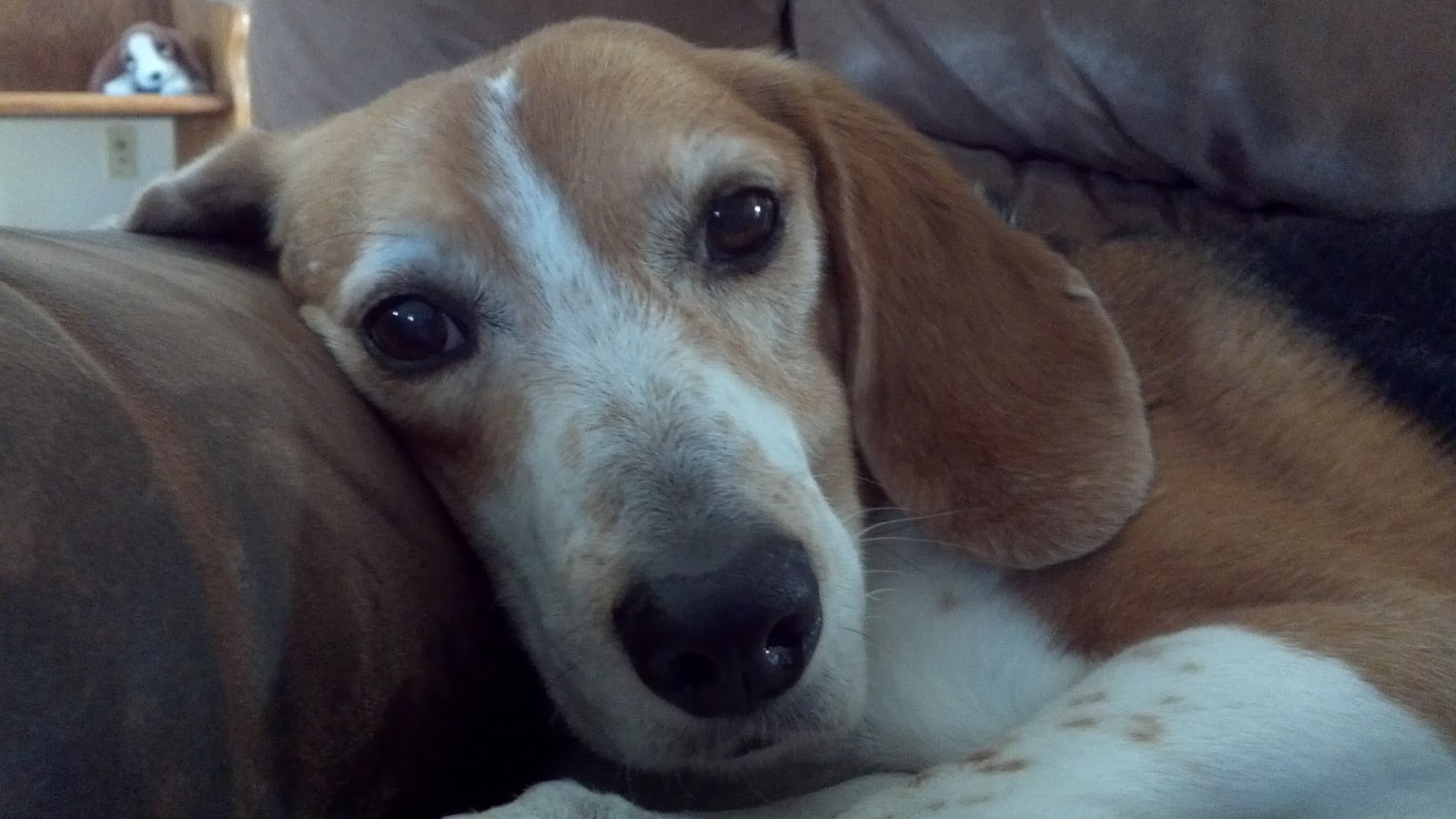
"And when they've given you their all
Some stagger and fall, after all it's not easy
Banging your heart against some mad bugger's wall"
-Pink Floyd
Friday, February 17, 2017
The Final (Mephitidae) Solution
The drain at the bottom of the window well was covered with stones; the corners showed evidence of digging. I didn't immediately see it, but tucked in the near corner I saw the unmistakable black and white stripe.
This isn't a typical shallow, city window well. It sits about six feet deep and is only wide enough to serve as a code-compliant egress.
The skunk was not going to get out on its own.
All I could say was, "Now what..."

Skunks are only native to the Americas and much more prevalent in North American than South. Small, invasive pockets have at times shown up in Europe and similar species live in Indonesia and the Philippines. The French Pepe le Pew is geographically unlikely. Skunks are largely nocturnal and live lives seemingly ambivalent toward humans. Like humans, skunks are omnivorous and can survive on just about anything. They have poor senses and are not overly aggressive, with ability to spray noxious and painful (to eyes, etc.) stink as their main defense mechanism - that stink was the root of my problem.
Skunks hibernate in the cold winter months. However, it isn't the deep hibernation that bears or reptiles go through, as they'll occasionally come out to feed or when weather warms. It was the warm weather which probably brought out my new denizen. I had seen a skunk a few days prior while walking one of the dogs. The dog didn't see the skunk until it was only about 20 yards away. The skunk didn't see us until it was already walking away. All it did after seeing us, was waddle on a little faster than before. A few other skunks lurking about as potential road kill preceded the skunk in my window well.
"Now what..."
As I saw it, I had a three options.
1-Ignore the problem. This was akin to choosing immobility as a mode of transportation.
2-Help it get out.
3-Kill it.
I was intent on avoiding two manifestations of the largest problem with the great striped one.
a-Me getting sprayed.
b-Skunk spraying in the window well as this might mean I'd have to burn the house down and hope insurance would cover it.
Skunks are largely burrowers, with limited ability to climb. I tried to lower a board into the window well as a ramp to get out, but every time I did this, the skunk exhibited nervous behavior. This, in turn, made me very nervous. At one point, the skunk turned around, raised its tail toward me in a show of bravado that I took quite seriously. Given the low probability of success, I abandoned this aided escape quickly. Stink looked far more probable than the skunk's ability to climb up the steep board out of the six foot deep window well.
I thought about trapping it in a bucket or live trap. And while, if successful, this would help the immediate situation, ultimate success without getting sprayed was far from assured. While I don't necessarily feel bound by the letter of the law, especially in the rural area where I live, Ohio Revised Code requires trapped skunks be released on site or euthanized. Releasing skunks elsewhere (transportation comes with its own unique challenges) is not legal. As an aside, this is also not legal for raccoons, beavers, possums, foxes and coyotes.
I was pretty much down to option 3-Kill it. But how?
In the late 1990's, I helped some farm friends rid their barn of skunks after a large group of them found a nice home in the barn with ample food supply in the form of the barn cat's food. Despite several well placed shots, every skunk got their last dying revenge. My farm friends were not disappointed. Going in, they were willing to trade intense skunk smell for a definite amount of time for the constant din of skunk stink that had been going on for most of the summer.
Shooting my skunk from the roof of my house would be a realistic option to avoid me getting sprayed, but would be nearly guaranteed to have odoriferous consequences in the basement, if not the whole house.
I went to my local hardware store for some advice. We tossed around potential solutions. We all saw some humor in the situation, but no clear solutions.
They handed me the card of a local nuisance animal company. I had already searched this option online and saw that best case scenario, I was looking at a cost in the low 100's of dollars - with absolutely no guarantee of the house coming out stink free. I called the number which gave options to press 1 if an emergency or leave a message in the general mailbox. I had a hard time seeing it as an emergency, but any prolonging of the situation seemed likely to increase the likelihood of stink.
I was approaching The Final Solution, and I didn't like it.
Ohio revised code allows the use of a "toxicant or chemical substance as a means of control for nuisance wild animal" but unlawful to use these "contrary to or in violation of instructions on the label or manufacturer recommendations."
I saw two embodiments of a "toxicant or chemical substance" at the local hardware store that listed skunks - Atlas Giant Destroyer and Amdro Gopher Gasser. Both of these are flammable smoke bomb type devices. Meant to be used in a burrow, I wasn't sure how well it would work in the more expansive window well and I had visions of this also filling my basement with "toxicant or chemical substance." This did give me the idea of using exhaust gasses from my ATV or copious dry ice to asphyxiate the skunk. I think this might have worked, but it would definitely have been an experiment. All of these gaseous products brought memories of a recent news story where an entire family inadvertently was poisoned by rodent killer. I did avoid the product that used zinc phosphide as the active ingredient...
There were several other mouse killers that used bromethalin, which is effective on skunks. Was I using it contrary to or in violation of instructions on the label or manufacturer recommendations? No, I've had mice in the window well, and they needed to be controlled (right?). The mouse nuggets smelled quite tasty, even if they are an asshole redneck tactic. Why that site goes on to give advice about poison seems quite contradictory. And if mouse poison is "an asshole redneck tactic" for skunks, why is it not for mice, rats, gophers, etc.?
I went down in the basement later that night and looked through the window with a flashlight. I have to admit that the skunk looked rather cute, it put its paws up on the window screen and almost looked like a zoo exhibit through the glass. I was reminded of running over a raccoon a few months prior.
One of my biggest concerns that first night was that the skunk might not be alone - and other neighborhood skunks would go all Baby Jessica overnight. Thankfully, skunks are somewhat solitary creatures.
The next day the skunk was still alive, although it was less lively. I provided it with another snack and beverage. As I was lowering this slowly into the window well by means of a string, I felt like I should be saying something analogous to: It puts the lotion on, or it gets the hose again. See the movie Silence of the Lambs if that doesn't make sense. In many ways, the EPA (or is it the FDA? Or CDC?) have hamstrung us. Current chemical control substances are so limited in potency that immediate effect is nearly impossible. Wide availability of extremely strong poisons might need to be approached with caution; there may be alternative solutions online. These are in a legal grey area, and time to acquire them didn't permit it.
The Final Solution was eventually successful. I didn't feel good about the situation; it took longer than I would have liked. It looked unpleasant.
In addition to the skunk, I've had coyotes, moles, deer, ground hogs, mice, rabbits, snakes and all manner of what some would consider vermin live harmoniously in and around the house. One of the things I love about living in a rural area is the unexpected interaction with wildlife.
But the line does have to be drawn somewhere.

Sunday, June 19, 2016
Trees

Every year since moving into my current house, I plant a few trees. Every year a few of them die, either newly planted or seemingly established.
The trees I've planted range from some I've lovingly grown from seeds to a row of arborvitae that have become little more than a mowing headache. I have quite the emotional attachment to the small paw paw trees grown from seed taken from trees that marked the location of my dog's final resting place. Happily, they seem to have survived a very late freeze this year, despite loosing some of their new growth.

Sometimes I think I should just give up and grow bush honeysuckle. I'm quite sure that it would take over the whole world if given the chance; if they ever colonize mars, they should bring that plant along and find a way to turn it into food since I'm sure it would also grow even in Mars' harsh atmosphere.

There is a hazy plan to my planting, with nothing directly in front of the house, evergreens to the west and south, and deciduous to the northeast. The evergreens are mainly screen trees and wind breaks. I've lost a few planted by the previous owners and have replaced them. The newer short guys look to their bigger brethren for inspiration.
Sourcing trees is very troublesome. What is available at the big box stores is usually pretty disappointing and is expensive for what it is. I'm not sure where they come from, but I suspect they are grown very far away since once planted they do, at best, tolerably adequate. I've had even less success with bare root stock delivered by mail order. Mail order sounds very 1980s. Should it be called internet order? Or catalog order?
"Seed catalogs are responsible for more unfulfilled fantasies than Enron and Playboy combined." - Michael Perry
I sometimes think bare root stock should be called dead root stock. Even with the success of the arborvitae, I don't think I'll go that route again. The local Soil and Water District does an annual tree sale. A few of these have stuck it out, but overall success rates are abysmal. At least cost is nearly negligible. There have been some of these that have soldiered on mightily, despite being froze, dug up, eaten by rabbits, etc. I'll attribute this to being native trees grown nearby. Most recently, potted trees from local growers are showing some promise. Prices can be wildly variable, but some of the smaller operations have a lot to choose from for very reasonable prices.
I'm somewhat partial to trees that are native to the area, but will try just about anything that looks hardy. My deciduous trees are almost all native species, with the exception of a few ginkgo trees; since these were once thought to be an extinct dinosaur from Pangaea, I guess they could be thought of as native to both everywhere and nowhere.
I really love paw paw trees. I planted several of these at my previous house and once established, they did fantastic, eventually becoming gorgeous large, tropical-looking trees that bore copious amounts of fruit, as long as the flowers didn't freeze in the spring. They are not quite as happy at the new house, since they do best as an understory tree and the little trees planted in the last few years get too much sun.
In addition to the ginkgos and paw paws, I have sassafrass, maple, oak, peach, and whatever the root stock was after the cherry tree graft died. I also have one tree that I had given up for dead and now no longer remember what it is - I suspect it is a pecan, but it may be some kind of chestnut. I'm quite surprised at the difficulty I've had with both the maples and oaks.
This year's deciduous tree additions were a couple buckeye trees. Buckeyes have quite a taproot (as do paw paws), so they do not transplant well. But I had little to lose, so I thought I'd try to transplant some from the edge of a nearby field. There is a small wooded area between two farm fields that had some small trees. I wasn't sure who owned the ground they were on, but they are in an area that is frequently brush hogged, so I didn't have any qualms about taking them. Once I decided this, I wanted to get them planted before the end of the spring season, so on an early Sunday morning, I drove down to dig them up. While doing so, I realized that I had made a situation that was assuredly perfectly acceptable with permission look preposterously suspect instead: On the edge of a field in the wee hours of the morning digging up some "plants." As expected the transplanted trees died exceedingly quickly. Shortly thereafter, I bought some yellow buckeyes from a local nursery and again found myself looking like I was engaged in questionable behavior. I picked up the trees and drove home with them inside the cab of my truck, since I didn't want the tree to be horrendously ripped apart by the wind on the 50 mile trip home. Any idea what buckeye leaves could look like to Joe LawEnforcement if they aren't familiar with them?

So far, these buckeye trees are doing well.
Planting trees often seems pointless. So many of them die; best intentions, even with water, do not sustain botanical life. What I do hope, is that over time enough of them will survive. Trees grow stealthily, never changing size during day to day monotony, but little by little inch their way up. My kingdom will never be one Roger Cook would be proud of, and this is OK. Hopefully I'll pull into my driveway some day and realize that I have my own mini unkempt forest.

"No, I understand now," Auberon said, calm in the woods - it was so simple, really. "I didn't for a long time, but I do now. You just can't hold people, you can't own them. I mean it's only natural, a natural process really. Meet. Love. Part. Life goes on. There was never any reason to expect her to stay always the same - I mean 'in love,' you know." There were those doubt-quotes of Smoky's heavily indicated. "I don't hold a grudge. I can't."
"You do," Grandfather Trout said. "And you don't understand."
- From Little, Big by John Crowley
"You do," Grandfather Trout said. "And you don't understand."
- From Little, Big by John Crowley
Sunday, December 6, 2015
Dad's Christmas Cookies
For at least the last decade, Dad always sent Christmas Cookies. These were large cookies decorated with copious amounts of frosting to look like Santa Claus, at least mostly like Santa Claus. While the gesture was nice, most were never eaten - something I always felt a little guilty about.
Dad was diagnosed early in 2015 with pancreatic cancer. He had some unusual issues, and after a few misdiagnoses, late stage four pancreatic cancer was confirmed. I knew pancreatic cancer wasn't "a good one" to get, but until doing some reading, I didn't understand the degree of badness to this, especially at the stage he was at.
Dad was always a rock. He was never flashy, never flamboyant or loud, or boisterous. There were prayers for the miracle-cure which wasn't to come; my Dad and his wife said those prayers were answered in thousands of small miracles after his diagnosis, which was yet another lesson I needed to learn from that man.
In the classic sense, I guess we weren't close. Our interests were very different. I usually (only) saw him once or twice a year. I communicated with him 10-20 times a year in addition to our visits - yet his diagnosis and the realization that his life would likely end, and soon, from pancreatic cancer hit me like a boulder.
All of my Dad's kids got together about a month after his diagnosis for a rally-around-Dad weekend. On one evening, Dad showed a slide show of 35mm slides from our youth on his father's very antique slide projector. Dad assumed this would be, at best, tolerated. It was probably one of the highlights of my year. We all really enjoyed watching the pictures and reliving childhood memories - creating new memories in the process.
We all had a great time that entire weekend - and it wasn't until the drive home that I realized why his diagnosis hit so hard.
Time spent thinking and putting thoughts to paper helped me put into words how with a strong foundation, Dad was able to help raise five interesting kids that were able to develop freely into their own very unique and independent selves. I ultimately sent this to him for Father's Day - almost too late - and read it at his funeral.
All of my Dad's kids got together about a month after his diagnosis for a rally-around-Dad weekend. On one evening, Dad showed a slide show of 35mm slides from our youth on his father's very antique slide projector. Dad assumed this would be, at best, tolerated. It was probably one of the highlights of my year. We all really enjoyed watching the pictures and reliving childhood memories - creating new memories in the process.
We all had a great time that entire weekend - and it wasn't until the drive home that I realized why his diagnosis hit so hard.
Time spent thinking and putting thoughts to paper helped me put into words how with a strong foundation, Dad was able to help raise five interesting kids that were able to develop freely into their own very unique and independent selves. I ultimately sent this to him for Father's Day - almost too late - and read it at his funeral.
I saw Dad a few more times over the spring and summer, watched the ever-healthy man deteriorate. He never complained, never lost faith. Just like his whole life, he was accepting and enjoyed every single positive second. Early on, there was a lot of communication, but that waned as his condition worsened. Updates, both good and bad, came mostly from his wife - a woman who showed the strength of Samson and compassion of Mother Teresa.
Dad died on Father's Day. Maybe because I saw him the day before, I see his death on a day to honor dads as inexplicably non-negative. His funeral really was a celebration of his life, as well as a roller-coaster of emotions since there were many people there who I hadn't seen in years.
Since Dad's death, I miss him in ways I never could have imagined.
I miss how he would read something I would post on Facebook, and then email me about it. I'm not sure if his lack of Facebook comments was that he didn't totally get it, or his deference to my being a somewhat private person.
I miss how he would always have some reason to email me after I saw him, and asked if I made it home OK.
I miss how he would always send me a really cheesy online birthday card.
I miss realizing that my habits and mannerisms had grown to match his more than I was comfortable with.
I miss just knowing ... he is there.
I miss how he would read something I would post on Facebook, and then email me about it. I'm not sure if his lack of Facebook comments was that he didn't totally get it, or his deference to my being a somewhat private person.
I miss how he would always have some reason to email me after I saw him, and asked if I made it home OK.
I miss how he would always send me a really cheesy online birthday card.
I miss realizing that my habits and mannerisms had grown to match his more than I was comfortable with.
I miss just knowing ... he is there.
And I miss those Christmas Cookies I didn't eat.
To be honest, I have a hard time seeing Dad make and decorate cookies; there is a lot I learned about him in his last few months that is difficult to picture. But the cookies would come every year, very near, sometimes shortly after, Christmas, when my taste for sweets of any kind was diminishing. There would always be an email preceding the cookies that "something was coming" for me. A rumpled box would then show up, with cookies wrapped in cellophane and bubble wrap.
It hurts a little knowing that that box will never show up again, and I will still feel guilty about not eating those cookies. Maybe this year, I will make some cookies, and I will frost them to look like Santa. But I will not eat them - because whether it is Christmas, or Father's Day or any time in between, when I think about my Dad, I don't ever want it to be without a little bit of ache.
To be honest, I have a hard time seeing Dad make and decorate cookies; there is a lot I learned about him in his last few months that is difficult to picture. But the cookies would come every year, very near, sometimes shortly after, Christmas, when my taste for sweets of any kind was diminishing. There would always be an email preceding the cookies that "something was coming" for me. A rumpled box would then show up, with cookies wrapped in cellophane and bubble wrap.
It hurts a little knowing that that box will never show up again, and I will still feel guilty about not eating those cookies. Maybe this year, I will make some cookies, and I will frost them to look like Santa. But I will not eat them - because whether it is Christmas, or Father's Day or any time in between, when I think about my Dad, I don't ever want it to be without a little bit of ache.
Sunday, February 1, 2015
A Beagle Named Soda

"How old is she?"
That is what I almost always heard when people learned that Soda was 18. Life expectancy of a beagle is on the order of 12 to 15 years. To say Soda had a good dog's life at almost 19 would be an understatement.
I got Soda in April of 1999. Mandy had recently died and that caused a hole that just needed to be filled. I knew it was irrational, but I was hoping for the pyrite to be gold and the dog I got after Mandy would be just like her.
I was at one of the local Pet's Plus (or some other similar store) and a nearby county was holding a dog adoption event. In the mix of dogs was a lanky female beagle. She had a somewhat diminutive personality and was almost shy. She went home along with a free bag of dog food.
I think she came with the name of Sprocket, but it was changed on the way home to Soda. The origins of this name are from Seinfeld, where George Costanza suggested the name of Soda to another character on the show for her child. It seemed to fit well for a dog (plus I really liked the show Seinfeld).
Soda was clearly in a state of stress. She had very little fur, with a few nearly bald patches on her side and belly. The fur she did have was very short and bristly. It was obvious that things were not exactly sweetness for her. She also had a funny pink spot on her nose. Over her life her hair became soft and normal, but the pink nose remained as a testament to her early years.
Once at home, the shy diminutive dog evaporated and Soda became a bundle of unlimited energy. This energy was not channeled in a good direction. She was absolutely ballistic!
She would race around the back yard barking at nothing and everything. While the yard was very large and fenced in, almost no fence could hold her. She found every nook and and tiny break in the fence, managing to squeeze out of holes a fraction of her size.
When all the small holes were finally sealed, Soda learned that if she pushed hard enough, she was able to get under the fence.
When she did get out, she was impossible to catch. She would run through icy creeks, bawling her fool head off. She was completely oblivious to anything, sometimes running right past me at top speed, only caring about the mythical thing she was chasing, probably the long-gone scent of some small animal.

After the bottom of the fence was secured at significant expense with landscaping timbers, Soda learned to be able to jump over the fence. She figured out that with just the right jump, she could get her "armpits" on the top of the fence, and then use her back legs to flop over. I'm convinced that this had to hurt, but the pain was worth it to her to get to the "greener grass" on the other side.
Sometimes the other dogs would follow along on her criminal advetures. Often, Sammy, Dixie and Lucky would just stand at the fence and watch her leave. This was often a good signal to look for where Soda got out and the direction she had gone in.

Soda spent a lot of time inside the fenced in yard and tied up to a chain. This was often the only way to keep her from running to some distant goal that was incredibly important to her. She really did not like this though.

With Soda's maniacal focus on anything real or imagined, she was the only dog I had where I understood how somewhat got rid of her. She shredded the bark on threes trying to climb them if she thought there were squirrels in them. She dug countless holes trying to catch moles. She tore down baby paw paw trees; I'm not sure why?
But, I'm not exactly sure why she did many of the things she did. At times, I know I lost my temper with her. This never seemed to phase her much though - perhaps that is a lesson for me.

Still, Soda did have her moments. She was a beagle who absolutely loved being outdoors. Rain, snow, sleet, heat - it didn't matter. Soda liked being out in her back yard. I guess in that way, we were a lot alike.
She was actually able to catch and kill a huge rabbit in the back yard once; the only one of my dogs where I've seen this.
Like all of my beagles, Soda was good at power-napping and could go from light-speed to sleep quickly.

As Soda got older, she did begin to mellow. Sitting inside would become more than tolerable. The back yard was interesting enough that only rarely did she feel the need to escape the fence or destroy a tree.

For the last few years at the old house and the first few in the current house, she really was a pretty good dog.

As an old, aloof beagle, Soda did have friends who adored her. The vet loved her and the last time she was kenneled during a vacation, she was given free run of the place anytime the person cleaning the kennels was back there.
Like all of us, she did start to age. She began to have small accidents in the house. These would mostly happen while she was sleeping so we had to put a dog towel underneath her for a while, wherever she sat. A prescription of Proin did wonders and stopped this for a while. However, she was also diagnosed at the same time with the beginnings of kidney failure.
Soda was put on special food for her kidneys, since minimizing phosphorus and some proteins can help. This made a difference for a while and I'm sure it prolonged her life, but she hated it. Just about every renal dog food available was tried. Soda would tolerate some longer than others. Iams Renal Plus was the one that she hated the least. Often, gravy, or canned renal dog food was needed to coax her to eat.
I'm not in favor of crating dogs, but eventually soda needed to be locked up when left alone in the house during work, etc. The daily moppings and/or washing of the small boot rug by the door was too much. A wire crate with a puppy pee pad became her daily resting spot.
What is amazing about most dogs and Soda in particular is how plastic they are. I'm sure the crate was a big change for her and I know she didn't like it, but she very quickly accepted it as the new normal. A few times she would even voluntarily walk into the cage.
At 17, I figured her days were numbered, but she soldiered on for another year. At 18, I wondered if I should renew her dog tags, but I owed her at least that much.

A few weeks ago, it became obvious that the end was probably near. Eating was becoming more intermittent and she was already very skinny. She still loved being outside though. I was really hoping she would go quietly and naturally, but that wasn't the case. Coming home from work, she really couldn't even walk and it appeared she might be having small seizures.
I called the vet to make her last appointment, and had an incredibly hard time maintaining my composure on the phone.
The vet had a nice room set up to be able to say goodbye in a non-hospital like manner. Soda's heart was so weak that an IV wasn't possible, but our vet helped her let go peacefully. It was the second time I had to put one of my dogs down, and it was just as hard as the first time; it was also the right thing to do.
No, Soda wasn't my favorite dog, but that long, gangly, independent dog had been running around the house for nearly 17 years. Even though there are still two beagles, the house didn't feel the same without her.
In a last act of Soda-ism, she died during a winter cold snap. The vet offered to keep her until spring, but after buying a pick-ax and a stronger shovel I was able to chisel through half a foot of frozen ground and reach thawed earth to dig a spot for her burial. This was not fun, but I was incredibly grateful that I could do this as I didn't want to open that raw wound and bury her in the spring. Sometime around the anniversary of when I originally got Soda, a tree will be planted over her.
And I'm sure, given most of her life spent running after anything and everything, that tree will attract more squirrels than any other in the yard.

Subscribe to:
Posts (Atom)